


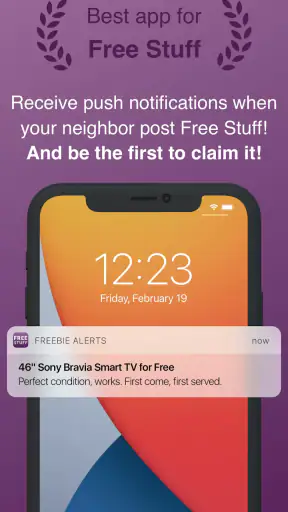
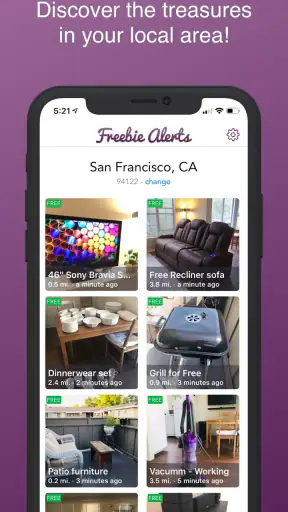

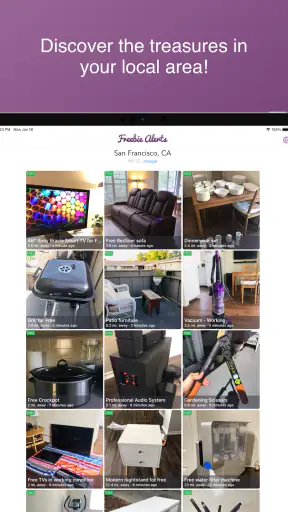
Freebie Alerts: Free Stuff App is the kind of social app that can be genuinely useful when you are already looking for something practical, but it rewards patience more than constant browsing. I used it as a local free-item finder rather than treating it like a normal shopping app, and that distinction matters. Its purpose is to bring nearby giveaway posts into one place, helping you notice items offered through services such as Nextdoor, Letgo, OfferUp, and TrashNothing.
The basic idea is simple: instead of checking several neighborhood platforms one by one, you use one feed and notifications to watch for free items. That can save time, especially if you are furnishing a room, clearing a household need, or trying to reuse something before buying it new. At the same time, the app does not turn free listings into a guaranteed supply of useful goods. Availability depends on your area, how quickly other people respond, and the quality of the original posts.
What using Freebie Alerts feels like in everyday life
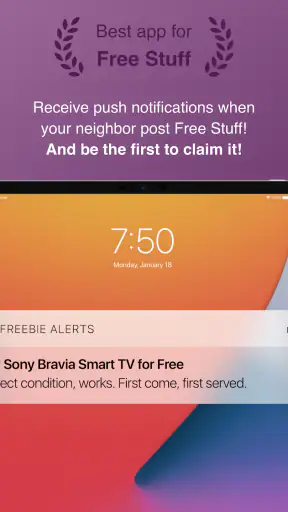
The app sits in the social category, but I found it more practical than conversational. It is not mainly a place to build a profile or maintain a community. Its value comes from helping you discover local offers that may disappear quickly. A notification can point you toward a chair, box of household items, moving supplies, or another unwanted object that someone nearby would rather give away than throw out.
A realistic use case is moving into a new apartment. Instead of buying every small item immediately, I could watch for free listings while making a short list of what I actually needed. The useful workflow is to check the alert, read the original post carefully, decide whether the location and pickup conditions are reasonable, and then contact the person through the relevant service. That last step is important: the app helps surface opportunities, but the exchange itself still depends on the platform where the listing appeared.
I also see value for people who are decluttering. If you are willing to collect items locally, a free-item alert can help you find materials for storage, repairs, hobbies, or donation projects. Parents, students, renters, and people furnishing a first home may get more out of it than someone who only wants a particular product immediately.
The main trade-off is speed versus noise. Free items attract attention, so a worthwhile post may already be claimed by the time you open it. Alerts can also be less useful when your area has many low-value listings or when the available items are too far away. I would not install this expecting a steady stream of perfect finds. I would install it as a background tool that occasionally prevents me from paying for something I could reasonably obtain nearby.
How it differs from checking each marketplace yourself
The most obvious alternative is to open Nextdoor, OfferUp, Letgo, or TrashNothing separately. Doing that gives you more direct access to each service, but it also creates a repetitive routine. Freebie Alerts is attractive because it reduces the number of places I need to remember to check. For someone who only wants one specific marketplace, using that service directly may be clearer and may provide more complete context.
There is another difference from ordinary shopping apps. Shopping apps are designed around search, comparison, and purchase. This app is closer to a local opportunity monitor. The item may be free, but pickup time, distance, condition, and communication effort still have a cost. I found that the best results came from deciding in advance what kinds of items were worth collecting, rather than reacting to every alert.
Compared with neighborhood social networks, the app is more focused. A neighborhood network may include announcements, discussions, recommendations, and local concerns alongside giveaway posts. Freebie Alerts narrows attention toward free stuff. That focus is convenient, although it means I still need the original service when I want broader background about the person, post, or local conversation.
Trust starts with knowing what the app actually does
The developer is listed as Freebie Alerts - Free Stuff Alerts, and the app is free to install. It has reached over five million installs, with a 4.7 average from around 270 thousand ratings and roughly 30 thousand written reviews. Those figures suggest that the idea has found a substantial audience, but popularity alone is not a substitute for checking whether the workflow suits you.
The app is intended for a Teen audience. That is a useful reminder that local giveaway exchanges should be approached with ordinary caution, particularly when an item requires meeting someone, traveling to an unfamiliar place, or sharing contact details. I would involve a trusted adult for younger users and avoid treating a notification as an endorsement of the listing or the person behind it.
The current version is 3.9.5, and it supports Android 7.0 or later. That makes it accessible on many older Android phones, which is appropriate for an app that people may want running quietly in the background. Still, an older device can handle notifications differently depending on battery-saving settings, so a missed alert may be caused by the phone rather than the listing service.
Controls I would check before relying on alerts
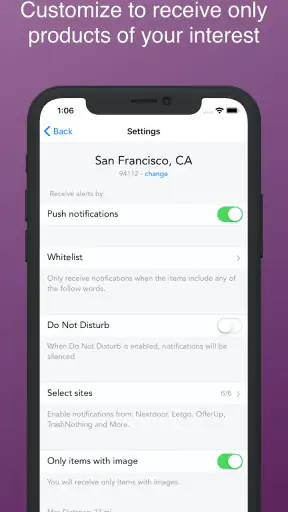
The first control that matters is notification behavior. I would begin with alerts enabled only if I genuinely want rapid updates, then adjust the phone’s notification settings if the stream becomes distracting. For free listings, timing can matter, but constant interruptions can turn a useful tool into background clutter. A sensible compromise is to keep alerts active while testing the app, then reduce them if most notifications are irrelevant.
The second control is location awareness. Local usefulness depends heavily on where the app is looking for listings. I would review any location choices presented during setup and avoid granting broader access than I am comfortable with. If the app offers a way to define an area manually, I would prefer a practical radius rather than monitoring places I would never visit. I am deliberately treating this as a user decision: the exact options visible on a device should be read carefully rather than assumed.
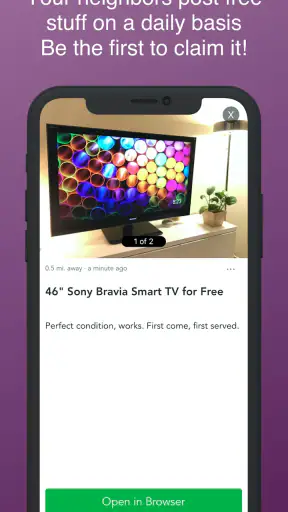
The third control is the path from an alert to the original post. I would not rely on the short notification alone. Opening the source listing lets me check whether the item is still available, whether pickup details have changed, and whether the description contains conditions that were not visible in the alert. This is one of the most important habits with an aggregator: the alert is a lead, not the complete transaction.
Because the app connects you with listings associated with several services, I would also think separately about those services. Freebie Alerts may help me discover a post, but any account, message, or profile interaction required by the original platform should be considered on its own terms. I would avoid assuming that one app’s controls automatically manage every other service involved in the exchange.
Data-sensitive moments deserve extra attention
The most sensitive moment is not necessarily installing the app; it is responding to a local listing. A free item can require a pickup address, a phone number, direct messages, or a meeting arrangement. I would share only what is needed to coordinate the exchange and would avoid posting my home address publicly. If a seller or giver pressures me for unnecessary personal details, I would treat that as a reason to stop rather than a normal part of collecting a free item.
Location is also worth considering because local alerts are useful precisely when they are relevant to an area. I would review the permission prompt in plain language and choose the narrowest option that still supports the feature I want. I would then revisit the permission in Android settings if my use changes. A person who only checks occasional listings may prefer less ongoing access than someone who wants immediate nearby notifications.
Messages and external accounts create another boundary. If the original listing platform requires an account, that account may have its own profile information and communication settings. I would keep my public profile minimal, avoid moving a conversation to an unfamiliar channel without a good reason, and inspect the visible choices before accepting requests or sharing details. These are not reasons to reject the app; they are practical safeguards for a service built around real-world exchanges.
I would also be careful with the meaning of “free.” A listing may involve travel, carrying equipment, waiting, or arranging a time when another person is present. If the item is bulky, I would confirm dimensions and pickup conditions before committing. This protects both privacy and time: fewer unnecessary conversations mean fewer occasions to reveal information or make a trip for something unsuitable.
Ways to get better results without chasing every alert
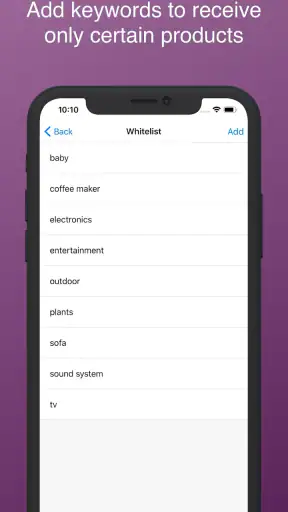
My first useful tip is to create a short priority list before opening the app. For example, I might watch for storage items, moving materials, or a specific type of furniture rather than treating every free object as valuable. This makes the alert stream easier to evaluate and reduces impulse pickups. It also helps me notice when the app is not producing enough relevant results for my neighborhood.
My second tip is to prepare a quick decision checklist. I would ask whether the item is actually needed, whether I can transport it, whether the condition is acceptable, and whether the pickup location is sensible. Free items often feel urgent because someone else may claim them, but urgency should not remove basic judgment. A thirty-second check can prevent a wasted trip or an awkward exchange.
My third tip is to use the app as a discovery layer and the source service as the verification layer. I would open the original listing, read the full text, inspect any available photos, and check the latest status before contacting anyone. This workflow is slower than tapping the first notification, but it is much more reliable. It also helps distinguish an active giveaway from an old or incomplete post.
A fourth insight is that timing and flexibility matter more than a narrow wish list. If I am willing to accept a different color, brand, or style, I have a better chance of benefiting from local reuse. If I need an exact model by a fixed date, a normal retailer or dedicated marketplace may be a better choice. Freebie Alerts works best when I can adapt to what appears instead of demanding that the local supply match a precise shopping plan.
Finally, I would set a personal stopping rule. If several alerts lead to unavailable items or trips that are too far away, I would pause notifications rather than keep checking out of habit. The app is supposed to save resources, not consume an evening. This is especially important for people who are sensitive to notification overload.
Where the experience can become frustrating
The biggest limitation is the uncertainty built into free local listings. The app cannot make an item available, improve its condition, or guarantee that a person will respond. A notification can arrive after another user has already claimed the item. That is not necessarily a flaw in the alert concept, but it affects how much confidence I would place in it for urgent needs.
Another friction point is uneven local coverage. In an active neighborhood, the app may feel worthwhile because alerts arrive often enough to justify checking them. In a quieter area, the feed may be sparse or filled with items that are impractical to collect. Someone living far from the main activity in their region may get better results from a local community group or a single marketplace with stronger participation nearby.
There is also a difference between convenience and completeness. Combining sources is helpful, but I would not assume that every detail from every service appears identically in one place. When the item matters, I would always verify it at the source. Users who prefer to see the full context, comments, seller history, and platform-specific tools in one native environment may be happier using each marketplace directly.
The app includes optional in-app purchases priced from $1.99 to $9.99 per item. Since the core app is free, I would first use it long enough to understand whether the alerts are relevant in my area before paying for anything optional. I would also read the purchase screen carefully and decide whether the added convenience solves a real problem. Paying does not change the basic uncertainty of local supply or guarantee that a wanted item will still be available.
Who should use it, and who should skip it
I would recommend trying it if you are comfortable with local pickup, can respond flexibly, and enjoy reusing items. It is particularly suitable for people furnishing a home on a budget, organizing a move, finding temporary household supplies, or reducing unnecessary purchases. The free price makes experimentation easy, and Android 7.0 support means you do not need a recent phone to test the basic idea.
I would be more cautious if you dislike communicating with strangers, cannot travel for pickups, or need guaranteed availability. It is also a poor fit for someone who expects a polished catalog with standardized descriptions and reliable delivery. This is a local-alert tool, not a replacement for a retailer, a delivery service, or a carefully filtered secondhand marketplace.
Privacy-conscious users can still consider it, but they should make permission and communication choices deliberately. I would review notification and location settings, keep external profiles limited, and avoid sharing unnecessary personal information. If those steps feel like too much work for occasional free items, checking a familiar local service manually may be the better compromise.
My cautious verdict after using it
Freebie Alerts is useful because it addresses a real annoyance: free listings are scattered across several local services, and good opportunities can be easy to miss. I like the idea of one place for discovery, especially when I am flexible about what I need. The app becomes most valuable when I use it with a clear purpose, verify every promising post at its source, and treat notifications as possibilities rather than promises.
My recommendation is therefore positive but measured. I would install it for a move, a home project, or a sustained effort to find reusable items, then tune the alerts around my actual routine. I would not keep it permanently active if the local results are poor or if notifications begin to outweigh the savings. The strongest reason to try it is convenience; the strongest reason to stay careful is that every exchange still depends on real people, real locations, and the separate services behind the listings.
For a free social app from Freebie Alerts - Free Stuff Alerts, the experience is focused and practical rather than glamorous. Its 4.7 average and audience of over five million installs show broad interest, but my decision would come down to local usefulness and personal comfort with the exchange process. If those two pieces line up, it can become a smart way to spot nearby reuse opportunities. If they do not, direct browsing on the marketplace that matters most to you will probably be simpler.


